
Showing posts with label strategy. Show all posts
Showing posts with label strategy. Show all posts
04 August 2010


26 November 2009
Resonance - what to do next
A short film by Continuum called “Resonance,” talks about the importance of consumer insights in generating design ideas. While most of us will be familiar with their approach and methodologies, it is a worthy case study of a clear presentation of services that caries a sense of transparency and honesty.
04 November 2009
Is planning impotent? A series of interviews about overcoming planning's identity crisis.
24 August 2009
A new advertising agency for companies that would rather outsmart the competition than outspend them
I'm currently reading Juicing the Orange by Fallon and Senn. Blown was I, when my eyes hit the third page. The third page shows the opening ad of Fallon McElligott Rice. A manifesto with an almost absurd amount of copy. Certainly because straight down (long)copy ads were long time out of fashion by the time the ad ran, July 20, 1981. They felt it was essential to articulate their vision. Twenty-five years later, the statistics are worse, and globalization and technology have changed the marketing environment, but the solution is the same: applied creativity. I read the tiny typeset ad 4 bloody times in a row. Because it was a nifty crafted piece of copy, but mostly because what the ad said was so "now" even though it ran 28 years ago.
Like so many in our business I find myself a numerous amount of times listening to some self-proclaimed guru who walks the talk and thinks he himself should be awarded a medal for sharing his mastermind visions with you. More often than not scraping pieces from manifesto's of some decades ago. It sickens me to see and hear these gut-shots claim eternal greatness while the same story has been told much better by guys who've shaped the industry years ago. Lots of people waive Ogilvy's rules and bold statements as old fashioned and out of business. But, many seem to have forgotten that he cemented the foundations of the industry, and envisioned the rise and importance of Direct long time ago. He should be studied and praised by everyone who tries to advertise anything at all. As too for this legendary Fallon ad which I've included further down this post. Of course one must note that the ad sings widely from the Bernbach bible but its message and content remains key to what most agencies strife for nowadays.
A new advertising agency for companies that would rather outsmart the competition than outspend them.
"I know that only half of my advertising works. The trouble is I don't know which half."
— John Wanamaker
If you're spending money on advertising, you've probably wondered: Is anybody out there listening?
The answer to that question is a shock.
Consider the following facts: American business will spend over $54 billion on advertising this year. According to one estimate cited in The Journal of Advertising Research, that money will buy over 200 thousand messages per person, or approximately 560 messages every day for every man, woman and child in America.
Of those 560 messages, the average person will notice only 76.
Of those 76, only 12 will be remembered.
And of those 12, 3 will be remembered negatively.
From 560 to 76 to 12 to 9 — an attrition rate of more than 98%!
Sobering isn't it?
But the news gets worse before it gets better.
The clutter trap.
In an effort to counteract the dwindling effectiveness of their messages, more and more companies increase their media frequency.
This leads to clutter.
Advertisers like Wisk and Sanka, once content to run their shrill, tedious commercials several times a week, now may run them several times an hour, trying to bore their way into the consumer's consciousness.
Ironically, while the number of messages (and media costs) have doubled in the past several years, consumers pay less attention than ever before.
In fact, a growing body of evidence suggests that increased frequency may actually be self-defeating.
In 1976, The Harvard Business Review warned,
"Heavy media spending can even work against you... repeated exposure to an advertisement may give rise to what psychologists label 'perceptual defense', to irritation, or even outright rejection."
Raising awareness, Not budgets.
It's clear that if you want to be one of the precious few that are remembered — less than 2% — you've got your work cut out for you. Outspending the competition is increasingly expensive and, as we've seen, may even work against you.
Instead of trying to outspend the competition, why not try to out-think them? With messages so interesting that even the most indifferent consumer will stop and look.
According to researcher Daniel Starch, one advertisement can outperform another advertisement for the same product in the same media at the same time by 500%.
Obviously, the preferred way to improve effectiveness is not to increase the spending level of your advertising, but to increase the interest level of your advertising.
Scarcity of imagination.
Unfortunately, raising the interest level of your advertising is easier said than done. The creative imagination to make great advertising — advertising that builds bridges between products and customers — is rare.
As The Harvard Business Review once observed,
"...creativity is like peace. Everybody wants it, everyone seems to have some ideas about it, but nobody seems able to produce it."
Once every several years, however, an advertising agency with the ability to produce truly exciting, original and compelling advertising appears. Fallon McElligott Rice is such an agency.
Although we've just opened our doors, the campaigns we've created at past agencies are famous. They've won market share for our clients, and a lion's share of awards for us. They've been studied in journalism schools, and copied by our competitors. In every case, these campaigns seemed like they had more money behind them than they did.
The ideas weer big; the budgets small.
What we believe.
At Fallon McElligott Rice we believe in advertising the way Ray Rubicam, Leo Burnett, David Ogilvy and Bill Bernbach once practiced it.
We believe that imagination is one of the last remaining legal means you have to gain an unfair advantage over your competition.
We believe you shouldn't have to repeat yourself ten times to be heard once.
We believe there is no such thing as a "me-too" product, only "me-too" advertising.
And we believe that great advertising is, has been, and always will be created in full partnership with great clients.
If you're beginning to have some questions about whether anybody out there is listening to your advertising, perhaps you should talk to us. Soon.
We have a lot of ideas, a lot of energy, and a lot to prove.
This ad is everything I believe in, it is what drives most of us to fight the horror of adverbatims today. Please consider addressing me to talk about the content of this post in depth. Soon.
Like so many in our business I find myself a numerous amount of times listening to some self-proclaimed guru who walks the talk and thinks he himself should be awarded a medal for sharing his mastermind visions with you. More often than not scraping pieces from manifesto's of some decades ago. It sickens me to see and hear these gut-shots claim eternal greatness while the same story has been told much better by guys who've shaped the industry years ago. Lots of people waive Ogilvy's rules and bold statements as old fashioned and out of business. But, many seem to have forgotten that he cemented the foundations of the industry, and envisioned the rise and importance of Direct long time ago. He should be studied and praised by everyone who tries to advertise anything at all. As too for this legendary Fallon ad which I've included further down this post. Of course one must note that the ad sings widely from the Bernbach bible but its message and content remains key to what most agencies strife for nowadays.
A new advertising agency for companies that would rather outsmart the competition than outspend them.
"I know that only half of my advertising works. The trouble is I don't know which half."
— John Wanamaker
If you're spending money on advertising, you've probably wondered: Is anybody out there listening?
The answer to that question is a shock.
Consider the following facts: American business will spend over $54 billion on advertising this year. According to one estimate cited in The Journal of Advertising Research, that money will buy over 200 thousand messages per person, or approximately 560 messages every day for every man, woman and child in America.
Of those 560 messages, the average person will notice only 76.
Of those 76, only 12 will be remembered.
And of those 12, 3 will be remembered negatively.
From 560 to 76 to 12 to 9 — an attrition rate of more than 98%!
Sobering isn't it?
But the news gets worse before it gets better.
The clutter trap.
In an effort to counteract the dwindling effectiveness of their messages, more and more companies increase their media frequency.
This leads to clutter.
Advertisers like Wisk and Sanka, once content to run their shrill, tedious commercials several times a week, now may run them several times an hour, trying to bore their way into the consumer's consciousness.
Ironically, while the number of messages (and media costs) have doubled in the past several years, consumers pay less attention than ever before.
In fact, a growing body of evidence suggests that increased frequency may actually be self-defeating.
In 1976, The Harvard Business Review warned,
"Heavy media spending can even work against you... repeated exposure to an advertisement may give rise to what psychologists label 'perceptual defense', to irritation, or even outright rejection."
Raising awareness, Not budgets.
It's clear that if you want to be one of the precious few that are remembered — less than 2% — you've got your work cut out for you. Outspending the competition is increasingly expensive and, as we've seen, may even work against you.
Instead of trying to outspend the competition, why not try to out-think them? With messages so interesting that even the most indifferent consumer will stop and look.
According to researcher Daniel Starch, one advertisement can outperform another advertisement for the same product in the same media at the same time by 500%.
Obviously, the preferred way to improve effectiveness is not to increase the spending level of your advertising, but to increase the interest level of your advertising.
Scarcity of imagination.
Unfortunately, raising the interest level of your advertising is easier said than done. The creative imagination to make great advertising — advertising that builds bridges between products and customers — is rare.
As The Harvard Business Review once observed,
"...creativity is like peace. Everybody wants it, everyone seems to have some ideas about it, but nobody seems able to produce it."
Once every several years, however, an advertising agency with the ability to produce truly exciting, original and compelling advertising appears. Fallon McElligott Rice is such an agency.
Although we've just opened our doors, the campaigns we've created at past agencies are famous. They've won market share for our clients, and a lion's share of awards for us. They've been studied in journalism schools, and copied by our competitors. In every case, these campaigns seemed like they had more money behind them than they did.
The ideas weer big; the budgets small.
What we believe.
At Fallon McElligott Rice we believe in advertising the way Ray Rubicam, Leo Burnett, David Ogilvy and Bill Bernbach once practiced it.
We believe that imagination is one of the last remaining legal means you have to gain an unfair advantage over your competition.
We believe you shouldn't have to repeat yourself ten times to be heard once.
We believe there is no such thing as a "me-too" product, only "me-too" advertising.
And we believe that great advertising is, has been, and always will be created in full partnership with great clients.
If you're beginning to have some questions about whether anybody out there is listening to your advertising, perhaps you should talk to us. Soon.
We have a lot of ideas, a lot of energy, and a lot to prove.
This ad is everything I believe in, it is what drives most of us to fight the horror of adverbatims today. Please consider addressing me to talk about the content of this post in depth. Soon.
16 July 2009
Proximity BBDO opens a new agency called The Farm

The Farm is an exclusive summercamp for graduates.
Talented and ambitious starters will be challenged to start a new agency. Proximity BBDO will train 12 graduates and take them through the world of digital and interactive marketing.

Last Wednesday we screened 56 graduates and selected 12 to form two teams this summer. 1 team contains 6 profiles: an Account Executive, a Strategic Planner, an Art Director Online and one Offline, a Copywriter and a Web/Graphic Designer. This summer our 12 recruits are: Laura Verstraeten, Olivier Berger, Helen Bogaerts, Sofie De Clercq, Tom Vingerhoets, Nicolas Moerman, Kasper Vandenbussche, Sven Augusteynes, Jolijn Gijssels, Sven Thierie, Maarten Lauwaert and Bram Ceuppens.
In 3 weeks, the 'intensive program' will cover interactive workshops about social media, viral marketing en brand building. Amongst the tutors are many celebrated leaders of the Direct & Interactive divisions of Proximity BBDO, one of Belgium's largest full service agencies.
The Farm is a professional intensive training program, offered free of charge. Attendees will be housed in a supplied mansion just outside Brussels - http://www.villakortenberg.be
The 'best of class' will be send out to one of the networks' best agencies abroad.
03 April 2009
Strategy, technical and designer walkthrough of Pepsi Max: Max It ARCADE 2009

Summary:
6 real claw machines can be controlled and played on from your browser. Pepsi Max combines bytes and atoms. If you're passionate about something, max it. That is what Pepsi Max is all about. That and gaming of course. And how do you go about maxing a game that everyone is passionate about? You think bytes (as in 'internet'). You think atoms (as in 'real world'). You grab a soldering iron and connect both.
—
Full post:
MAX YOUR THOUGHTS
Take 6 real claw machines, hook 'm up to the internet and start playing. Unique codes can be stripped from the Pepsi Max bottles and used to add up for extra gaming credits. The lucky ones can win some cool prizes or grab a ticket for the final during which one plays with an 8 meter tall claw machine containing really huge prizes! Each finalist will be able to grab a huge bear and possibly win sunjets.be trips to Malta or Tenerife, or take home 50" plasma's and other cool Panasonic stuff.
OLDSKOOL CAMPAIGNING
The campaign is kick-starts with traditional online media. Bannering and an enticing e-mail to a database of Pepsi Max aficionados
SOCIAL MEDIA CUM
Today, more than 2.1 million belgian citizens are an active member of Facebook. So we integrated the power of Facebook Connect to make the game easily portable over the users contact network. Everyone registering with Facebook credentials, receives give-away codes for friends. Everytime anyone plays or wins it shows up in their friends newsfeed. How's that for viral?
Frankly, a huge amount of users can freely access the website but only 6 can play simultaneously. Of course these users don't want to be sitting ducks while waiting for a claw machines to become available. Statistics are put up to check when the site is very busy, a concept we introduced with, and was essential to, the Internet Is Mine case. Also, the claw machines Twitter when one of the slots is available.
KICK-ASS DESIGN
Phase 1: First wireframes were made in Powerpoint. They served as a basic feature-spec for the full website.
Phase 2: After being loosely briefed on the campaign’s concept and features, several paper sketches were made to serve as a rough guide. The concept at this stage was “a carnival or arcade, but maxed out!”.

Phase 3: Taking the best sketches into Photoshop, we created a digital painting that would serve as a moodboard and colour guide. This piece was also shown to the client in order to get the go-ahead for the look-and-feel for the rest of the website. You’ll also notice the (not-so) subtle use of Pepsi’s 3 main colours, creating a symbolic link between the logo and the site.

Phase 4: Using photos of the real grabber machines as reference, 3d models of the six cabinets, as well as a large “hero”-crane - a reference to the real-life final phase of the competition. The models were created and rendered in 3ds max 2008.

Phase 5: After all 3d models were animated and rendered, all assets were composited in Adobe After Effects and Photoshop. The mist was painted by hand.

Phase 6: After the final compositing of the scene, everything was then taken into Adobe Flash, where it was animated and integrated with the rest of the UI, which was also designed in Photoshop.

SOME HARDCORE GEEKNESS
Basically the client, your pc at home, simply browses to the webpage loading the Flash application. Through the Flash application the Socket Server receives the data of the logged in user and pushes that info to an Application Server on the same layer. The Application Server is there just to check the user data. N00bs would refer to this step as "checking with the database". Furthermore the Socket Server just relays feedback between the claw machine and the UI. To put it straight, the Socket Server is the connection between the client and the claw machines at our offices. If a connection is established then that triggers the Socket Server and extracts one credit. Whenever a client is logged and ready to play, the Socket Server checks whether the user still has available credits to play the game. Credits can be added by entering game-codes found on Pepsi Max bottles and cans.
So, the Application Server feedbacks on the user-request and talks back to the Socket Server. Finishing this simple cycle the Socket Server pings to one of the 6 computers hooked to a claw machine. Each one of these computers is linked to a claw machine through 6, USB interface, micro-controllers talking to one of 6, physical, claw machines.
The micro-controllers allow users to address the physical controls of the claw machines. The connection between the two buttons to navigate and the coin collector are intercepted and thus hijacked by the USB interface of the micro-controllers. The micro-controllers send the claw machines the same electrical signals normally send by the original connections of the physical buttons.
The bears in the claw machines are stuffed with an RFID-tag. If a user manages to catch and lift a bear, the bear is dropped into a slide passing an RFID-chip reader. Once the reader is triggered a signal is passed on back to the Socket Server. The Socket Server then checks that tag with the linked prize in the DB inside the Application Server. When the match is made the UI displays to the user what prize he, or she, has won.
By the way, Proximity BBDO is looking for more ambitious developers willing to enforce our team and start create more of these wicked web-apps and games. Anyone with an interest can apply here.
Check out more of our geekness at Adnerds.be and check the conversation at #pepsimax, #twapero and #proximitybbdo
17 March 2009
The simple 10 of online collaboration
1. Forums. Yes, forums seem very old-school Web 1.0. But they are an effective tool and are being updated by vendors and included in integrated online collaboration services.
2. Wikis. This is currently a hot space, hugely competitive with many vendors, but also with a lot of adoption. Wikis nicely fit the gap between email (which is unstructured and bad for creating shared content) and traditional content management systems (which are too process-intensive).
3. Blogging. Blogs and comments are a good way to spread and find information.
4. Microblogging. The 140-character limit forces brevity, a huge blessing in the corporate context! There are many "Twitter for the enterprise" offerings. They feel more like features than distinct products, ripe for integration in larger offerings.
5. Document workflow. This seems really old school, even pre-Web 1.0, but most business processes require a document of some type. Some vendors are putting these features in the cloud as well as integrating them with other collaboration tools.
6. Email. We don't even think of this as collaboration. It's just what we do all day, every day, like breathing. But the evolution of email and its integration with other tools is an area seeing a lot of innovation.
7. Document creation. This is the office on the web, the online alternative to MS Office on your hard drive. Collaboration capabilities are the driver for this market.
8. Conferencing. Whether for text, voice, or video chatting or screen-sharing for demos, web conferencing is the alternative to expensive, eco-damaging, nerve-wearing travel.
9. CRM. As CRM moves more online, it becomes more about online collaboration. Some simple online collaboration tools can be alternatives to low-end CRM. We see opportunities in CRM 2.0 that really take advantage of online networking.
10. Contact networking. This is the space dominated by LinkedIn and Facebook. In our view, it is the key to CRM 2.0.

2. Wikis. This is currently a hot space, hugely competitive with many vendors, but also with a lot of adoption. Wikis nicely fit the gap between email (which is unstructured and bad for creating shared content) and traditional content management systems (which are too process-intensive).
3. Blogging. Blogs and comments are a good way to spread and find information.
4. Microblogging. The 140-character limit forces brevity, a huge blessing in the corporate context! There are many "Twitter for the enterprise" offerings. They feel more like features than distinct products, ripe for integration in larger offerings.
5. Document workflow. This seems really old school, even pre-Web 1.0, but most business processes require a document of some type. Some vendors are putting these features in the cloud as well as integrating them with other collaboration tools.
6. Email. We don't even think of this as collaboration. It's just what we do all day, every day, like breathing. But the evolution of email and its integration with other tools is an area seeing a lot of innovation.
7. Document creation. This is the office on the web, the online alternative to MS Office on your hard drive. Collaboration capabilities are the driver for this market.
8. Conferencing. Whether for text, voice, or video chatting or screen-sharing for demos, web conferencing is the alternative to expensive, eco-damaging, nerve-wearing travel.
9. CRM. As CRM moves more online, it becomes more about online collaboration. Some simple online collaboration tools can be alternatives to low-end CRM. We see opportunities in CRM 2.0 that really take advantage of online networking.
10. Contact networking. This is the space dominated by LinkedIn and Facebook. In our view, it is the key to CRM 2.0.
17 February 2009
Kinepolis: the extra mile

The extra mile, indicating the formidable length of my post on the e-strategy of Kinepolis, was perhaps a bridge to far what concerns webcopy. "Overnewsed but uninformed" totally fits the Zeitgeist. While nosing around on the internet you've probably noticed that often lots of people are covering one specific subject without passing on founded knowledge on the matter. Let alone giving insides or writing down something nobody else would possibly be able to put down in words. Luckily this wasn't entirely the case on this particular event. We had passed a great deal of 'bashing about', pissing on Kinepolis, repeatedly echoing each other on what was wrong with Kinepolis. Now, thanks to some fantastic bloggers and the therefor crucial event the echo-chamber had morphed and fresh thoughts had been released. "Overnewsed but uninformed" was my motto for digging really deep into the backgrounds that jumped this conversation. All that to share with you a deeper understanding of what is going and how this all came into place.
I know reading on the web isn't quite as inviting as reading a book. In the zone untenable by my own enthusiasm. The post was loaded with several sidestories and inside information leading away from the core idea that particular post was messaging.
Having finished writing it already dawned on me but I was to eager to hit the 'publish' button so I did. During writing I changed my status on LinkedIn into "writing a book on the e-strategy of Kinepolis, the largest host of movietheaters in Belgium", so I was very well aware of the fact that the post was stretching out that extra mile not a soul would reach to read. This morning I received an e-mail of friend and colleague Pietel. He informed me that he was interested in reading the story but pointed out that I should stick to 1 idea per post. He suggested extracting sidestories and indirect information on the topic into different posts, splitting the story, making it easier for readers to gain access to the original post, core of the topic within the vivid conversation roaring about Kinepolis at the moment.
@Pietel: you are right, having to scroll about 3 seconds to meet the bottom of the post, about 7 times an entire screen down the fold of a standard browser-window (1024*768), is a little pushing daisies.
Thus, this has been taken care of. The original post was split up into eatable pieces of blogwriting. Some of you might argue that the core post is still too long but I didn't want to alter the work I submitted on this topic.
I hope it serves your cause and treats your time with pleasing aftermath. Hereby the list of posts embracing my thoughts, observations and insights about a recently started conversation on 'Kinepolis':
» Think of it as Jujitsu. The ins and outs of Kinepolis' latest e-strategy. (original post, insights and background on the conversation)
» How it all started
» Calling in the bloggers
» Martial arts
» Marrying an agency
» Who is Druppels
» To media or not to media
» Join the conversation
Kinepolis: join the conversation
Please join the conversation at:
Tales of drudgery and boredom, Een scheet in een fles, Dipfico's daily, Blogging the news, An unexpected view to the world, Verwarring troef, Blogging in Balegem or De gustibus est disputandum.
More conversations can be browsed by using the widget displayed next, or you use a watchlist to monitor new entries.
Tales of drudgery and boredom, Een scheet in een fles, Dipfico's daily, Blogging the news, An unexpected view to the world, Verwarring troef, Blogging in Balegem or De gustibus est disputandum.
More conversations can be browsed by using the widget displayed next, or you use a watchlist to monitor new entries.
Kinepolis: To media or not to media

Today, it is often debated whether it is better to use mainstream, or must I use 'traditional', media or the so called social media online for getting your message through. Though the question is not which is better, the question should rather be: what are you trying to achieve, what goals have you set, what targets are you chasing. Social media is all about talking, establishing a relationship with that customer, rather than just saying "here I am, have you seen me?". Social media can have their value, but talking is not always appropriate for a company or a brand. It all depends let's say, the big change here is that now, other than before, companies are choosing. Choosing whether to push, talk, interact, engage, listen or ... shout.
Kinepolis: Who is Druppels

Druppels, Frédéric De Vries, started working at ProximityBBDO October 2007. First as a Strategist completing a special unit called 'Innovation'. A unit created to guard and amplify the level of creative output of the freshly started merger called ProximityBBDO. It existed of 4 specialists. This unit worked as a satellite orbiting the giant hairball, functioning a plug-and-play unit engaging with the different departments inside the organization. This unit could be referred to as 'a wild-card team'. Druppels creative companions were Adriaan van Looy and Wim Provoost. Frédéric De Vries, former These Days and DigiPoint, is now a Creative Director at ProximityBBDO. Which explains the lack of time for writing decent studied blog-posts like this one. I have to add that killer Aikido training, a fast car, barking dog and biting new girlfriend also add up on his personal time-sheet. I report to "Fré" directly, as he is responsible guarding the Online Art Directors at our company.
Kinepolis: marrying an agency
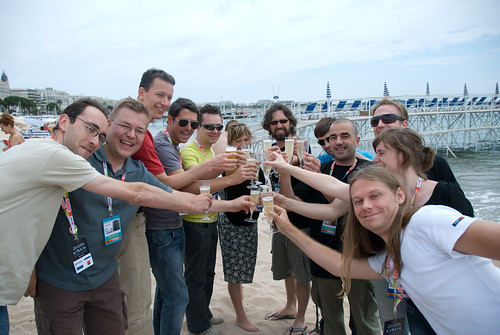
Not too long ago, Kinepolis chose ProximityBBDO as their sparring partner for talking to their customers. Talking yes. By now most companies have understood that pushing the message through mainstream media doesn't always bring value for money. Kinepolis currently owns and hosts 23 cinema complexes in Belgium, France, Spain, Poland and Switzerland, and employs about 1600 people.

Kinepolis: Martial arts
Jujitsu is mostly known for it's key attribute: turning the attacker's force against him. Some amongst the martial arts experts would argue that the martial art of Aikido is better known for this attribute but that's not quite the point of this article. Of course there's no need to tell you that the force of this new era is that of the consumer. Consumers have the power, consumers are in charge now, no need to keep repeating that. Important is this: consumers can raid on companies whenever they have the feeling they have been done harm, just like that, as long as they get support from others, as long as there is an audience they'll be listened to. So let me stop boring you and move on to the story here.
Kinepolis: calling in the bloggers

"Druppels welcomed the bloggers, together with the Adhese team, as they arrived at the scenery.
Tapping the Groundswell
Robin showed up first. Shortly after the majority of the invited influentials had walked through the door and the drinks were ready to be served the cosy chatter amongst the bloggers started. The crowd knows each other. It's been years since I've had this awkward feeling of being a newbie. I comfort myself with some statistics, namely, that I knew 5 out of 40 attendees. Recognized more than 50% by recalling their faces from flashing avatars. And had found least one somebody with which talking was as if I'd knew him for years, knowing how to handle a
Westside accent has some advantages after all. Bob's nerves were almost untenable. I think be that time he could have given that presentation upside down, he was totally in on it. Bob, Bob Claeys, heir to the Kinepolis heritage. Bob, Kinepolis board-member and by far it's most enthusiastic evangelist. This guy breaths Kinepolis, lives Kinepolis, is (partly) Kinepolis. He would tell the invited crowd about how this company had grown, about their strengths and recent investments in innovative technologies. He was sweating. Although Bob did a great job on bringing an story with flair and lots of juice, still the bloggers were left clueless about their reason being there. Clueless about why their precious time was being occupied. Clueless about why they had been served free drinks, a grim impatience started to arise in the tone of voice of the comment spread through the Twitter services. Bob was talking too long and too loud... A small break came about right on time and the audience moved to a less 'listen to me' kind of space. Food was served, well food. Some bloggers obviously expected more than finger-food and popcorn. The story continued and a new face stood before the gang of online frontiers. The one and only CEO of Kinepolis was ready to take on the beating if necessary, Eddy Duquenne, a brave man. It was time to tune out from the fairy tale of history and wake up. Eddy had a calm, charismatic and unnatural appearance of authority. It was as if he owned the placed. This wasn't a man under siege, he must have been hypnotized. No. He was there, feet to the ground, listening. He explained briefly why he had invited everybody present. He explained their new strategy of listening and talking and shortly after moved to the Q&A. Most Belgian readers amongst you undoubtedly can recall the painful moments plenty of speakers confront when speaking before a Belgian audience, silence. No questions. But this wasn't the case at all. The audience didn't jump him like an outrage mob, the questions were neatly lined up. Time was exploited to raise hands, ask questions and change thoughts. Eddy wasn't being to defensive at all. He left a divine impression.

That question
Then someone popped that one question: "why is the founder of that Facebook group called Kinepolis gaat erover not invited to this talk? He is the reason why we are here, right?".
Eddy smiled and sat his ass down. "Well, as a matter of fact, no, that is not why you are here. At least not entirely. Yes, he is the reason why we have shifted gear in what were working on. But it is not 'because' of him you are here. You are here mainly because we want to start talking with our customers. And we have not invited him because we wanted to emphasize the fact that he is merely the reason for us to shift gears. Also, he has blanked us out, swamping us with negativity and we want to push ourself in the right direction without being defensive, without counterattacking. We want to focus on these new pathways we have chalked down and start off with a clean street. We want to let our audience, our customers, know that we are here from now on. We want to get the message out that we are listening. We took note of every post, every line, written on
the the wall of that Facebook-group and we are working on some of those demands as we speak. I know we haven't been there in the past. And I know we aren't there at the present. But I know we are going to be there in the future. Yes, we are going to remodel our website. Yes, we are going to grease our online ticketing. Of course we want them to be cheaper (instead of the way around few months ago) than the tickets you buy 'offline'. No, we don't want to push the price of our tickets to an outrages amount. It keeps some people from coming to our venues as well remember. But hey, Rome wasn't build in one day. We are an organization tackling a broad range of issues and these things need time. We have to take it slow, one step at a time, think things over sometime, but rest assured we will go on." — wooaw, I mean I was blown away. I myself'd never expect him to be this blunt, honest, with the crowd. Chapeau! And sure, the price of Coke and popcorn bought from the shops inside the venues is out of line but hey what's new. If the Coke is to expensive don't drink it. If your children are nagging for popcorn till your skull starts to open up, give them an asswhoopin' or get a nanny and tell her "no popcorn". Get them a better education or tell them popcorn kills. If the tickets are too expensive, don't go there (sorry that's a joke, go there just skip one meal ;)) But of course, Kinepolis has quite a monopoly on housing movie-theaters in our country, I agree. On the other hand, they do have the best seatings and offer. If you want to seduce a new lover and it works, it is worth the money, right? And if it's not you can always try and hook on some colleagues.

Flawless victory
With Eddy answering a dozen questions flawlessly something dawned to me. I was thinking this guy should start writing a blog on his own. No doubt his analytics would skyrock shortly after the release. After all who wouldn't want to hear news from the captain himself. He has something to say, he has the authority and he has an audience that is eager to talk. But. I wasn't actually there on invitation. I was on his side. And I wasn't fully on top of things concerning the development of the relationship between the agency I work for and his company, Kinepolis, our client. Would I be out of line? I was already out of line for tweeting that the speaker was to loud. Would I be out of line asking about his thought on this, let alone proposing him to do so. I must have bitten my tongue somewhere between 20 and 30 times, my lips were burning. I admit to not be being in control of my enthusiasm in participating and raised my hand. Eddy looked at me, clueless of the fact that I was actually a ProximityBBDO employee. I blended in naturally. Flanked by Dominiek and Goedles on my left and Houbi on my right. I started activating the small zone in my brain that is used for talking: "You answer flawless to each one of these questions. Why don't you take on write a blog of your own? I can imagine a blog written by somebody of your authority would undoubtedly be warmly welcomed by your customers." He answered with confidence, calm and self-assured: "Oh I will. Soon my friend, soon. We're working on it." He meant, I, in the near future. Funny. I was satisfied. A client that leveled. Wonderful.
Kinepolis: how it all started
A Misty winter morning
Druppels vividly recalls that moment: "It was misty winter morning. We were staring at each other from the far end of the table. We all gathered in the Moutstraat, Ghent. It wasn't quite a celebration. The room was filled with a cold but damp air. We were at war, or rather, we were under siege, big time. It wasn't the economic crisis we were tortured by, no, it was the masses. Present were all Kinepolis board-members and 3 envoys of the agency. To Kinepolis it was Pearl Harbor, not single soul was spared." — @mvuijst: Druppels has frozen his writing activities due to a lack of time.
» Who is Druppels
Back to that chilly winter morning in Ghent. "A sigh, a thousand blinks and 4 gallons of coffee later action was undertaken. Yet, it took some more gatherings to get straight on the final plans but a brand new e-strategy was written. It was an ambitious one. A grand revival. Yes, the wisdom of the poker-gods is to be learned by heart; comebacks exist! We were scrambling all the possible guts a board could possibly think of and stood up facing 45000 joiners of a group that was based upon nothing but to destroy us."
Druppels vividly recalls that moment: "It was misty winter morning. We were staring at each other from the far end of the table. We all gathered in the Moutstraat, Ghent. It wasn't quite a celebration. The room was filled with a cold but damp air. We were at war, or rather, we were under siege, big time. It wasn't the economic crisis we were tortured by, no, it was the masses. Present were all Kinepolis board-members and 3 envoys of the agency. To Kinepolis it was Pearl Harbor, not single soul was spared." — @mvuijst: Druppels has frozen his writing activities due to a lack of time.
» Who is Druppels
Back to that chilly winter morning in Ghent. "A sigh, a thousand blinks and 4 gallons of coffee later action was undertaken. Yet, it took some more gatherings to get straight on the final plans but a brand new e-strategy was written. It was an ambitious one. A grand revival. Yes, the wisdom of the poker-gods is to be learned by heart; comebacks exist! We were scrambling all the possible guts a board could possibly think of and stood up facing 45000 joiners of a group that was based upon nothing but to destroy us."
Kinepolis: Think of it as Jujitsu
Think of it as Jujitsu
[» Martial arts]
The ins and outs of Kinepolis' latest e-strategy.

Kinepolis, originally uploaded by Pieter Baert.
To Kinepolis it had always been about shouting, talking without listening, assuming not asking. So when we sat around the table with Kinepolis for the first time, somewhere last year, we decided to take it one step at a time. [» How it all started] It seemed obvious we should start with listening. Luckily Kinepolis had build up a huge amount of contacts in their database (so sorry, I'm very bad at remembering numbers but I'd say like 400000 or so, could be lots more, I'm modest, if you know the number please comment) so asking questions would be to hard to get our 'new behavior' going. A large questionnaire was compiled listing a wide range of questions. The questionnaire was mainly focused on topics that concern the satisfaction of the visiting customer. Evidently this questionnaire is key for setting out the new goals Kinepolis and ProximityBBDO wanted to strive for. [» Marrying an agency] Gathering info on what the customer desires of a cinema and entertainment experience today is crucial for starting to build around the axis most important for creating a better Kinepolis. After all Kinepolis has been about
innovative drive and a customer-friendly approach from the start, so they say. The response rate on the questionnaire was satisfying, allow me to even say huge, enormous (again, damn numbers, comment-section please). That info is being scrambled as we speak. Of course just sending out a questionnaire and asking people "what would you do if you ran a cinema" isn't quite enough to get the ball on fire. It was the tipping point of the behavior change though. A green light to start engaging with the new way things work nowadays. Now the motor was up and running the wheel had to be grabbed and seat belt buckled up.
Next, without throwing out a bait, we would listen. Listen to what people are saying to each other about the Kinepolis venues, about the cinema experience, about how they live the entertainment. And where, of all places, could we hear that story best, indeed: the internet. The chance of picking up a conversation about Kinepolis by just walking up the street is nearly nonexistent. So we were designated to using watchlists, searchbots and alertservices for finding out where the conversations were taking place. The results, yes I'm honest from the top down, were rather negative. And
some conversations didn't just sit there being negative waiting to be discovered, no.
Some conversations were marching on, upwards, raving like a mad bull at a red blanket. I recall one night in a place called
the Matrix ...
A group called Facebook
Someone had started a new group on Facebook someone who didn't quite like the Kinepolis management. The group was called "Kinepolis gaat erover" (= Kinepolis crossed a line). By that time the group was supported by about 5000 fans, or joiners. By the end of that day the tribe doubled, vastly expanding, spreading like a lean mean virus. Kinepolis was 'attacked' by the power of the masses and they were not ready to talk back. As you know we were at the embryonal stage of sending out a bloody questionnaire. 2 days later, the founder (
David Callens), starred nationwide spitting out about what is wrong with the management of Kinepolis. Criticizing the organization top down, stripping it from it's pride, throwing all members of the board into a roaring ocean of bad news without being offered a life jacket. [» Who is Druppels]
David had a point on some topics, others were a shout out of unfounded madness but clearly a desperate cry for attention. Kinepolis had to start listening and it did. But, Kinepolis wasn't ready to take on this massive swing. And remained ducked down for the time being. Left, standing, out there, in the middle of nowhere. Naked. Beaten.
Spandex and speakers
In the eighties Kinepolis was a huge success. Mainly due to their innovative approach introducing THX Dolby Surround. "The audience is listening" was their motto those days. Nowadays they are bound to learn the hard way that "the audience is participating". Of course we were eager to help them out as it is as hard on us to see clients suffering as it is to mothers hearing their babies cry.
The tactics?
[» Calling in the bloggers]
Gather all (most...) influential bloggers in town (Belgium). Boys (and girls) with thousands of readers, an audience. Amongst which, lots of Kinepolis lovers and Facebook members. Tell them the story of that one local cinema that grew to be the international enterprise? it is now. Tell them the truth, be open and honest. don't hide, take it like a man and above all "don't get defensive". Listen. be transparent about yourself and your company and above all be human. Act normal. Talk. After all, it can't get any worse.
Nothing to lose.
The result was a cosy gathering of Belgian blogosphere influentials. But don't be fooled. It wasn't all that sunshine, happiness and rainbows. No. It takes great courage and nerves of steal to face a mob like them. Bloggers were called and invited by Enchante. Enchante specializes in business relationships with bloggers and positions itself as being able to establish the perfect link between a brand and the exact right blogger. These bloggers were invited without being given a thorough background of the situation.
I was there that evening.
Listen, think, talk
Inviting this specific crowd was a risk, to us, to Kinepolis. We could lose a client. They could drown a lot deeper, a lot deeper. After all this mass of bloggers represented a huge amount of '(online) media space'. There opinions post are were the eyeballs walk. The influencers were on our side. A crowd that is so trained in seeing scams through would have noticed on the spot if they were being tricked into a trap. It was obvious, we were naked. We didn't beg for help, a story was being told. An honest story, a story from the heart, transparent and sincere. The next day, the conversation started. Bloggers were pushing out and they were on our side. Of course still sceptical about many topics listed on the Facebook group. Of course criticizing current issues. But overly, positive. Moreover, David ended his activities on the Facebook group and posted out to
the 42891 members that his mission was accomplished. Kinepolis had listened to the Groundswell. Kinepolis had started talking. And now, so he ended, "dear Kinepolis, now, we are listening."
[» Join the conversation]
[» Martial arts]
The ins and outs of Kinepolis' latest e-strategy.

Kinepolis, originally uploaded by Pieter Baert.
To Kinepolis it had always been about shouting, talking without listening, assuming not asking. So when we sat around the table with Kinepolis for the first time, somewhere last year, we decided to take it one step at a time. [» How it all started] It seemed obvious we should start with listening. Luckily Kinepolis had build up a huge amount of contacts in their database (so sorry, I'm very bad at remembering numbers but I'd say like 400000 or so, could be lots more, I'm modest, if you know the number please comment) so asking questions would be to hard to get our 'new behavior' going. A large questionnaire was compiled listing a wide range of questions. The questionnaire was mainly focused on topics that concern the satisfaction of the visiting customer. Evidently this questionnaire is key for setting out the new goals Kinepolis and ProximityBBDO wanted to strive for. [» Marrying an agency] Gathering info on what the customer desires of a cinema and entertainment experience today is crucial for starting to build around the axis most important for creating a better Kinepolis. After all Kinepolis has been about
innovative drive and a customer-friendly approach from the start, so they say. The response rate on the questionnaire was satisfying, allow me to even say huge, enormous (again, damn numbers, comment-section please). That info is being scrambled as we speak. Of course just sending out a questionnaire and asking people "what would you do if you ran a cinema" isn't quite enough to get the ball on fire. It was the tipping point of the behavior change though. A green light to start engaging with the new way things work nowadays. Now the motor was up and running the wheel had to be grabbed and seat belt buckled up.
Next, without throwing out a bait, we would listen. Listen to what people are saying to each other about the Kinepolis venues, about the cinema experience, about how they live the entertainment. And where, of all places, could we hear that story best, indeed: the internet. The chance of picking up a conversation about Kinepolis by just walking up the street is nearly nonexistent. So we were designated to using watchlists, searchbots and alertservices for finding out where the conversations were taking place. The results, yes I'm honest from the top down, were rather negative. And
some conversations didn't just sit there being negative waiting to be discovered, no.
Some conversations were marching on, upwards, raving like a mad bull at a red blanket. I recall one night in a place called
the Matrix ...
A group called Facebook
Someone had started a new group on Facebook someone who didn't quite like the Kinepolis management. The group was called "Kinepolis gaat erover" (= Kinepolis crossed a line). By that time the group was supported by about 5000 fans, or joiners. By the end of that day the tribe doubled, vastly expanding, spreading like a lean mean virus. Kinepolis was 'attacked' by the power of the masses and they were not ready to talk back. As you know we were at the embryonal stage of sending out a bloody questionnaire. 2 days later, the founder (
David Callens), starred nationwide spitting out about what is wrong with the management of Kinepolis. Criticizing the organization top down, stripping it from it's pride, throwing all members of the board into a roaring ocean of bad news without being offered a life jacket. [» Who is Druppels]
David had a point on some topics, others were a shout out of unfounded madness but clearly a desperate cry for attention. Kinepolis had to start listening and it did. But, Kinepolis wasn't ready to take on this massive swing. And remained ducked down for the time being. Left, standing, out there, in the middle of nowhere. Naked. Beaten.
Spandex and speakers
In the eighties Kinepolis was a huge success. Mainly due to their innovative approach introducing THX Dolby Surround. "The audience is listening" was their motto those days. Nowadays they are bound to learn the hard way that "the audience is participating". Of course we were eager to help them out as it is as hard on us to see clients suffering as it is to mothers hearing their babies cry.
The tactics?
[» Calling in the bloggers]
Gather all (most...) influential bloggers in town (Belgium). Boys (and girls) with thousands of readers, an audience. Amongst which, lots of Kinepolis lovers and Facebook members. Tell them the story of that one local cinema that grew to be the international enterprise? it is now. Tell them the truth, be open and honest. don't hide, take it like a man and above all "don't get defensive". Listen. be transparent about yourself and your company and above all be human. Act normal. Talk. After all, it can't get any worse.
Nothing to lose.
The result was a cosy gathering of Belgian blogosphere influentials. But don't be fooled. It wasn't all that sunshine, happiness and rainbows. No. It takes great courage and nerves of steal to face a mob like them. Bloggers were called and invited by Enchante. Enchante specializes in business relationships with bloggers and positions itself as being able to establish the perfect link between a brand and the exact right blogger. These bloggers were invited without being given a thorough background of the situation.
I was there that evening.
Listen, think, talk
Inviting this specific crowd was a risk, to us, to Kinepolis. We could lose a client. They could drown a lot deeper, a lot deeper. After all this mass of bloggers represented a huge amount of '(online) media space'. There opinions post are were the eyeballs walk. The influencers were on our side. A crowd that is so trained in seeing scams through would have noticed on the spot if they were being tricked into a trap. It was obvious, we were naked. We didn't beg for help, a story was being told. An honest story, a story from the heart, transparent and sincere. The next day, the conversation started. Bloggers were pushing out and they were on our side. Of course still sceptical about many topics listed on the Facebook group. Of course criticizing current issues. But overly, positive. Moreover, David ended his activities on the Facebook group and posted out to
the 42891 members that his mission was accomplished. Kinepolis had listened to the Groundswell. Kinepolis had started talking. And now, so he ended, "dear Kinepolis, now, we are listening."
[» Join the conversation]
05 February 2009
Everything clicks better with Coke - reply to Bnox
A while ago Bnox pulled a list of famous brand names on Facebook. Coke was clearly taking the lead. Yet, Clo marked that she felt the advertising strategy of Coca-Cola didn't push getting their story and ideas translated to web-based media. I replied on "Everything tastes better with Coke", commenting this:
In my opinion you're not wrong but Coke has to be credited to a certain point here. Maybe they don't need this leverage. After all they're already the number one popular brand without having to really engage in social media. I think they see no need to dip into that well this far.
Yes partly it's true, Coke doesn't seem to succeed, or even make effort, empowering their brand within social media. They don't quite engage with their customers, yet. And if they do it's rather poorly or unsupported. Coke doesn't shock us with distinct community campaigns in astonishing ways other brands have. On the other hand I think Coke should not be compared to brands like Dell and Adobe who have a much larger and more defined online audience, and also have a lot more and suitable content to make their mark for engagements in social media. Dell and Adobe need this presence online for support reasons, Coke doesn't really. But then again they are putting in much effort to do so: http://www.cocacolabelgium.be/showpage.asp?iPageID=2 I agree with you on the "entirely unbloggable websites" part as much of this website is flashcontent.
Also, Coke does ignite the audience in the online environment though. Some of their latest campaigns were picked up by wide range of people. Which resulted in lots of chatter online and thus raised value for the brand. I remember a social/charity campaign supported with some very nice photography which was plastered all over design and photography blogs a while ago. And I would also like to point to the campaign called the Happiness Factory. Although there is no real interaction campaign, not as far as I'm aware of, they have created some kind of cult (call it community) around the creation of their Hapiness Factory saga. The spots were produced by top motioncompany Psyop ( http://www.psyop.tv ) Lots of people, especially in Europe weren't even aware of the fact that these series ( http://www.cocacolabelgium.be/Happiness-Factory---The-Movie- ) of Coke spots were actually one larger story, credits due Wieden&Kennedy Amsterdam. Short after W&K had uploaded "the making of" ( http://www.dailymotion.com/video/x2elp2_happiness-factory-behind-the-scenes_ads ) on their YouTube account it was removed kickstarting enthusiasts to repost the movie and rallying eachother to get there hands on a copy. Deliberate or accidental, maybe we should ask. Veerle Pieters wrote lots more on the Happiness Factory: http://veerle.duoh.com/blog/comments/coca_cola_the_happiness_factory/ I'll just post the additional links to the .mov files here so they can easily be downloaded by ALT clicking them :) http://www.movedigital.com/go/veerlepieters/90874/psyop_coke_ad.mov http://www.movedigital.com/go/veerlepieters/90875/Mockumentary.mov http://www.movedigital.com/go/veerlepieters/90876/happinessfactory-hi.mov
Unfortunatly their interactive presence on this story so far is limited to a somewhat lame set of games you can play at http://hf3.coca-cola.com/?locale=be_NL
At Cannes this year Ivan Wicksteed, Global Creative Director of Coca-Cola, shed light on how the company turned a 30-second ad into a marketing platform that is expected to last for 30 years. Now that’s something gutsy to put in your creative brief. It should provide enough content for advertisers to leverage the brand in many ways using this platform as a jumpstart. For all I care all characters from these episodes can be brought alive in social media ways... Also had the redesign of the Coke identity, which mainly existed of symplifying the brandimage, was awarded with Gold in the design category at Cannes last year. I so loved it. But you were talking about social media, right. I'm sorry (*).
For Coca-Cola, so I've read, it’s not what people buy, it’s what they buy into. ( http://www.marketingwithmeaning.com/2008/06/19/cannes-day-2-coca-cola-storytelling )
A last something I would like to point out would have to make your doubt about their lack of online effort vanish somehow. In my point of view the CokeZeroGame ( http://www.cokezerogame.de ) really did establish a strong interactive value for the audience. Not a single drop of energy was send to be spared when Coke briefed North Kingdom to create the interactive version of a full blown action tv commercial. Word goes taht this is the 'largest' online campaign production so far, whatever that means of course. The choice for briefing North Kingdom was no random act since North Kingdom is considered to be The Number One digital agency in the world. And so, North did one hell of a job creating a fully online game that made my vain pump like raving madmen ( http://demo.northkingdom.com/cokezerogame )
Yet, I still don't drink CokeZero. I guess, to me, having a presence in social media isn't always key to better sales, buying behaviour or even to the relationship I have with the brand.
(*) Maybe Google should limit the number of characters in the Blogger commentsection ;) See you around
In my opinion you're not wrong but Coke has to be credited to a certain point here. Maybe they don't need this leverage. After all they're already the number one popular brand without having to really engage in social media. I think they see no need to dip into that well this far.
Yes partly it's true, Coke doesn't seem to succeed, or even make effort, empowering their brand within social media. They don't quite engage with their customers, yet. And if they do it's rather poorly or unsupported. Coke doesn't shock us with distinct community campaigns in astonishing ways other brands have. On the other hand I think Coke should not be compared to brands like Dell and Adobe who have a much larger and more defined online audience, and also have a lot more and suitable content to make their mark for engagements in social media. Dell and Adobe need this presence online for support reasons, Coke doesn't really. But then again they are putting in much effort to do so: http://www.cocacolabelgium.be/showpage.asp?iPageID=2 I agree with you on the "entirely unbloggable websites" part as much of this website is flashcontent.
Also, Coke does ignite the audience in the online environment though. Some of their latest campaigns were picked up by wide range of people. Which resulted in lots of chatter online and thus raised value for the brand. I remember a social/charity campaign supported with some very nice photography which was plastered all over design and photography blogs a while ago. And I would also like to point to the campaign called the Happiness Factory. Although there is no real interaction campaign, not as far as I'm aware of, they have created some kind of cult (call it community) around the creation of their Hapiness Factory saga. The spots were produced by top motioncompany Psyop ( http://www.psyop.tv ) Lots of people, especially in Europe weren't even aware of the fact that these series ( http://www.cocacolabelgium.be/Happiness-Factory---The-Movie- ) of Coke spots were actually one larger story, credits due Wieden&Kennedy Amsterdam. Short after W&K had uploaded "the making of" ( http://www.dailymotion.com/video/x2elp2_happiness-factory-behind-the-scenes_ads ) on their YouTube account it was removed kickstarting enthusiasts to repost the movie and rallying eachother to get there hands on a copy. Deliberate or accidental, maybe we should ask. Veerle Pieters wrote lots more on the Happiness Factory: http://veerle.duoh.com/blog/comments/coca_cola_the_happiness_factory/ I'll just post the additional links to the .mov files here so they can easily be downloaded by ALT clicking them :) http://www.movedigital.com/go/veerlepieters/90874/psyop_coke_ad.mov http://www.movedigital.com/go/veerlepieters/90875/Mockumentary.mov http://www.movedigital.com/go/veerlepieters/90876/happinessfactory-hi.mov
Unfortunatly their interactive presence on this story so far is limited to a somewhat lame set of games you can play at http://hf3.coca-cola.com/?locale=be_NL
At Cannes this year Ivan Wicksteed, Global Creative Director of Coca-Cola, shed light on how the company turned a 30-second ad into a marketing platform that is expected to last for 30 years. Now that’s something gutsy to put in your creative brief. It should provide enough content for advertisers to leverage the brand in many ways using this platform as a jumpstart. For all I care all characters from these episodes can be brought alive in social media ways... Also had the redesign of the Coke identity, which mainly existed of symplifying the brandimage, was awarded with Gold in the design category at Cannes last year. I so loved it. But you were talking about social media, right. I'm sorry (*).
For Coca-Cola, so I've read, it’s not what people buy, it’s what they buy into. ( http://www.marketingwithmeaning.com/2008/06/19/cannes-day-2-coca-cola-storytelling )
A last something I would like to point out would have to make your doubt about their lack of online effort vanish somehow. In my point of view the CokeZeroGame ( http://www.cokezerogame.de ) really did establish a strong interactive value for the audience. Not a single drop of energy was send to be spared when Coke briefed North Kingdom to create the interactive version of a full blown action tv commercial. Word goes taht this is the 'largest' online campaign production so far, whatever that means of course. The choice for briefing North Kingdom was no random act since North Kingdom is considered to be The Number One digital agency in the world. And so, North did one hell of a job creating a fully online game that made my vain pump like raving madmen ( http://demo.northkingdom.com/cokezerogame )
Yet, I still don't drink CokeZero. I guess, to me, having a presence in social media isn't always key to better sales, buying behaviour or even to the relationship I have with the brand.
(*) Maybe Google should limit the number of characters in the Blogger commentsection ;) See you around
Subscribe to:
Posts (Atom)